economic solidarity
Acts of the ApostlesEconomic solidarity names a defining practice of the community moving toward the Realm: material goods are treated as resources for one another’s security, not merely as private possessions. In Luke’s vision, sharing answers immediate need and gives a present, communal form to the abundance associated with the coming age. It joins worship and proclamation to the practical question of whether people can live without anxiety about survival.
Meaning and Material Practice
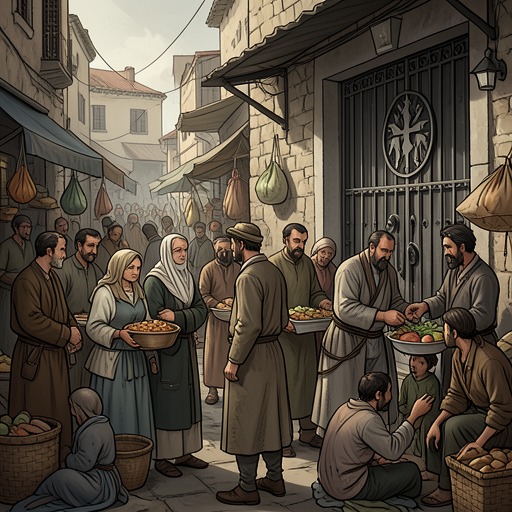
Luke’s picture of the early church in Acts 2:43–47 is widely recognized, though many scholars understand it as an idealized memory rather than a straightforward record of historical practice. Like other ancient accounts that portray a community’s origins as a golden age, it sets out values against which later life can be measured. The believers are described as being “all together,” a phrase that signals more than proximity: they understand themselves as a genuine community prefiguring the life of the Realm. Their common life makes the ideal tangible.
The account’s claim that the believers hold all things in common is not a call to separate spiritual life from material provision. They sell possessions, including land and houses, and place the proceeds in a common treasury, from which resources are distributed so that no one is left in need. Luke presents this sharing as a means through which God’s providential care reaches people. Material security matters in itself: the Realm is not a spiritual alternative to material abundance but a new world in which people can share it.
Acts 4:32–37 returns to the same motif. Repetition underscores how central shared goods are to the community’s identity. Its members are “of one heart and soul,” bound by common purpose despite differences in national origin and culture. Luke describes an arrangement in which no one claims private ownership and possessions are held in common. Scholars differ over whether people sold goods into a shared treasury or retained ownership and sold them as needs arose. In either account, the decisive principle is that goods are available for the common good.
Security, Mutuality, and the Realm
The material practice has both direct and symbolic force. Directly, shared resources relieve people of anxiety about obtaining what they need. More broadly, a willingness to place one’s physical resources at the community’s service expresses a response to the Realm. Luke contrasts the old-age use of goods for self-serving purposes, to the neglect of others, with the new orientation in which possessions support the community. What distinguishes the ages is not material life from immaterial life, but the social purpose to which material life is put.
Economic solidarity is therefore more than charitable contributions by individuals to people in need. Community members enter into mutual support, anticipating the material dimension of the Realm together. When people are less consumed by survival anxiety, they are more available for wider purposes of love, justice, peace, and mutual care. The practice also has a double significance for poverty and wealth: people in need receive immediate provision, while those with resources can resist greed and the elevation of wealth into an idol. Sharing offers the wealthy a place in a community where security is collective rather than accumulated privately.
Luke’s first portraits of common ownership do not describe every later stage of the movement. As Acts unfolds, believers appear to retain private ownership while regarding their goods as serving the community. The arrangement changes; the principle persists. That development cautions against reducing economic solidarity to one fixed property system, while preserving the demand that resources be directed toward common well-being.
Examples Across the Community
Joseph, a Levite from Cyprus, gives the ideal a particular human face. He sells a field and puts the proceeds into the common treasury. Luke’s identification of him as both a Levite and an immigrant makes the act significant across social boundaries: people from the priestly world and people who have come from elsewhere can recognize and support the movement toward the Realm. The apostles call Joseph Barnabas, interpreted by Luke as “child of encouragement.” His first act of encouragement is economic solidarity with the community. The example also warns against stereotyping those with whom one disagrees: shared commitment to the Realm can cross lines of background and institutional association.
The practice later links communities across geography and ethnicity. When Agabus predicts a severe famine during the reign of Claudius, Gentile disciples in Antioch send relief to believers in Jerusalem. The direction of the gift matters: Gentiles become an instrument through which God provides for the Jerusalem church. Their offering represents the renewed relation of Jewish and Gentile peoples and anticipates a prophetic vision in which Gentiles place resources in the service of the God of Israel. It is not simply a transfer between congregations but a material expression of their connected life.
The story of Lydia in Philippi offers another angle on resources and belonging. She is a Gentile seller of purple cloth, a commodity associated with wealth, and the head of her household. Through baptism, she and the household she leads enter the community of the Realm. Her presence signals that a person of means need not stand outside the church or fear its mission. Resources can become means of providence for others, while participation in shared life offers security that is not based on wealth alone.
From Charity to Economic Reform
The ethical force of the ideal reaches beyond a congregation’s charitable gifts. Luke’s presentation challenges communities to enter into economic solidarity and to confront economic structures that sustain poverty and widen the gap between wealthy and poor. This makes the text potentially threatening: it concerns not only an individual’s generosity but also the arrangements through which resources and security are distributed.
A preacher can follow Luke’s movement from a vivid portrait of communal life to an individual example. The vision establishes the values; Barnabas shows what participation in them looks like. Applied to the present, the pattern invites attention to particular people, groups, or forces working to reorganize economic life around the Realm’s practices. Congregational relief offerings, too, can be understood not only as charity but as practical solidarity and an anticipation of the coming age.
The description of common ownership should not be turned into a demand that every contemporary believer sell everything. Many people in Luke’s time expected the world to end soon and therefore did not anticipate the same long-term need for material resources. The present requires planning for the long term. That distinction does not cancel the passage’s challenge; it directs attention from copying a particular ancient arrangement to sustaining its central purpose: material security for all through resources put to the service of the community.